Banks, brokers and financial institutions ask clients to declare US tax status under FATCA. An office preparing the forms needs to know which form fits each client.
The short table
| Client | Form | Why |
|---|---|---|
| A US person — a citizen, a resident (e.g. a green-card holder) or a US entity | W-9 | Provides a US taxpayer identification number (TIN) |
| An individual who is not a US person | W-8BEN | Certifies foreign status |
| A non-US entity | W-8BEN-E | Certifies foreign status and the entity’s classification |
Who is a US person
- A US citizen — even one who does not live there, including someone born in the US.
- A green-card holder.
- Someone who meets the substantial presence test.
The substantial presence test
Per the IRS, an individual meets the test when present in the US at least 31 days in the current year, and 183 days over three years counting all days of the current year, one third of the days of the year before and one sixth of the year before that. There are exceptions — see the IRS page.
What about CRS?
CRS is the OECD standard for reporting tax residency across participating countries. Its self-certification is separate from the IRS forms, and the financial institution usually provides its own form.
How to do it in Joy
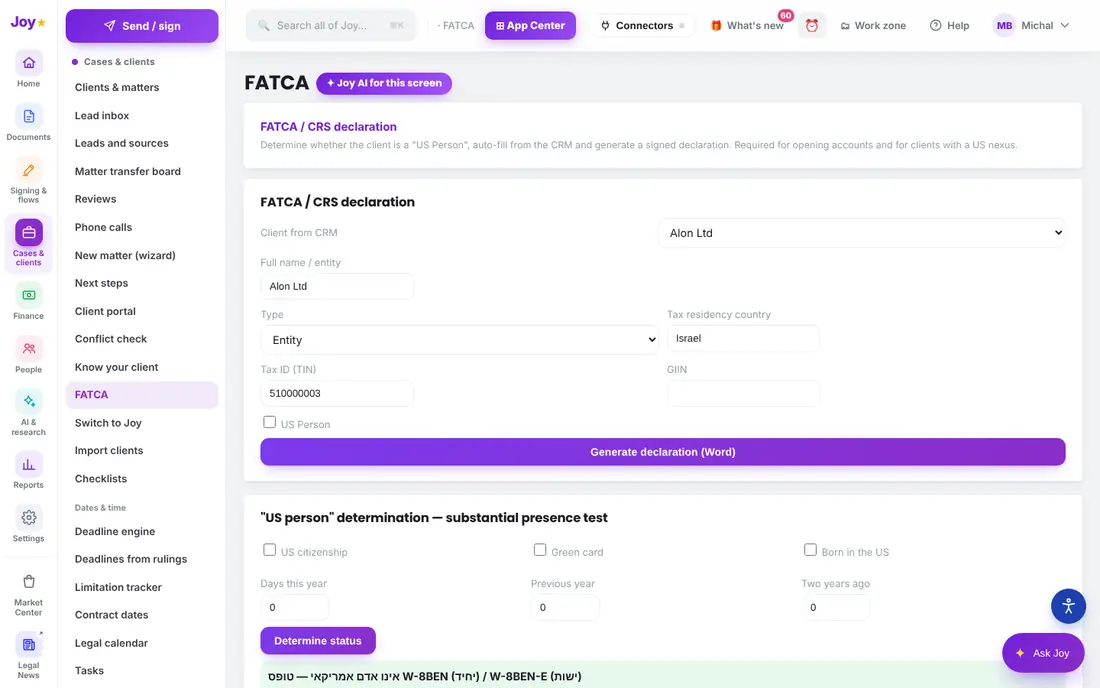
In the FATCA screen pick a client from the CRM: Joy fills the name, address, ID numbers and tax residency, computes the substantial presence test from the days of stay, suggests the matching form and produces a declaration in Word for signature.
This page is general information, not legal advice. Every rule is given with its official source; anything marked "to verify" must be checked against the current wording. Last updated: 15 October 2026.